


Summary for Jan. 28, 2020 #CdnELTchat: Authentic Listening Materials
Happy 75th to #CdnELTchat! When Nathan Hall (@nathanghall) and Svetlana Lupasco (@StanzaSL) started #CdnELTchat (also known as #LINCchat) in 2015, I taught evenings as a LINC instructor, and I had been feeling a bit isolated at the time. #CdnELTchat gave me a chance to connect with other Canadian ELT educators. I feel very fortunate to have the opportunity to be a part of the #CdnELTchat team and community of practice.
I would like to echo my gratitude to #CdnELTchat enthusiasts by quoting Claudie’s (@thespreadingoak) tweet, “Thanks ALL the dedicated generous participants who made this a viable authentic place 2 share EAL/ELT/ESL knowhow, enhance practice, give moral support.Onward and upward.”
If you are interested, take a look at the topics #CdnELTchat has covered in the previous 75 chats: #CdnELTchat Topics (2015 to present). What topics are you interested in discussing for the next 75 chats? Help us out by sharing your ideas on our Padlet: Questions and Comments for future #CdnELTchats.
We were fortunate to have Nathan Hall (@nathanghall) join us for the 75th edition of #CdnELTchat to talk about Authentic Listening Materials. Nathan is an EAP instructor and teacher trainer at Douglas College (@douglascollege). Visit his fantastic website (https://nathanghall.wordpress.com) for a variety of resources and ideas. Nathan started the discussion by sharing Morrow’s definition of an authentic text: “a stretch of real language, produced by a real speaker or writer for a real audience and designed to carry a real message of some sort.” (Morrow, 1977).
Here are the questions we used to guide our discussion:
Q1: What are the advantages of using authentic listening materials? #CdnELTchat
Q2: What guidelines should we follow when we choose authentic listening materials to use with our class? For example, what should the optimal length be for an authentic audio or video clip at different proficiency levels? #CdnELTchat
Q3: What kind of tasks work well with authentic listening materials? #CdnELTchat
Q4: How can we use authentic listening materials for assessment? #CdnELTchat
Q5: What specific listening strategies should we teach students before we use authentic listening materials? #CdnELTchat
It was a busy chat with participants from across Canada and beyond sharing almost 200 tweets. You can read these tweets that we’ve collected on Wakelet here, but here are some highlights from the discussion:
- Advantages to using authentic materials: exposure to messy language that learners will encounter in their lives including reductions, connected speech, different voices and accents, natural interruptions, unfinished thoughts etc., reinforcement that language is for real communication
- When using authentic listening materials, the length and complexity depends on the task. Longer listening texts can be used for tasks such as getting the gist or familiarizing students to the rhythm and flow of English. Shorter listening texts are better for bottom-up tasks. Scaffolding is needed to build confidence. Another option might be to slow down the audio and provide learners with options.
- Suggested tasks for authentic listening materials: decoding natural streams of speech and connecting that to pronunciation, recognizing turn-taking signals, interruptions, and functional language, following recipes, reacting to and applying what you hear; for EAP – note-taking, summarizing, and synthesizing, comparing how media platforms report the same news story
- Suggested ways to use authentic listening materials for assessment: note-taking tasks and group discussion on main points, assessing summarization skills over a period of time, assessing based on the type of listening, assessing specific skills/strategies (inferring from tone, inferring intent, summarizing, selective attention), avoiding summative testing and focusing on progression, observation of student ability instead of formal assessments
- Suggested listening strategies: exposure to certain types of skills with guided questions, strategies that help them cope with anxiety, strategies to help determine essential information, noticing tone of voice and speech patterns, recognizing purpose
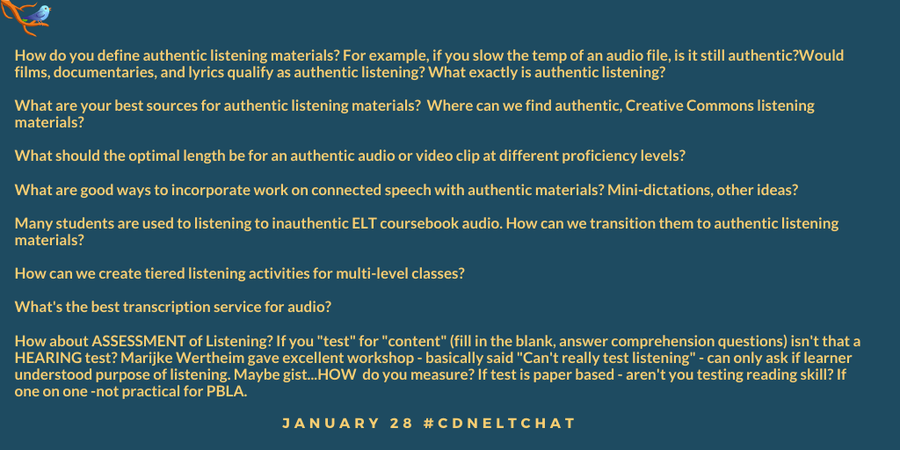
We encourage everyone to continue the conversation using the hashtag #CdnELTchat. Here are all the great questions that we didn’t have time to discuss during the live one-hour chat:

#CdnELTchat is a collaborative effort that we hope will lead to more reflective practice for all of us involved in ELT. If you have any ideas for topics or have comments about #CdnELTchat, please send @StanzaSL, @EALStories, @Jennifermchow, or @ELTAugusta a tweet. We are also looking for guest moderators who are interested in leading a future #CdnELTchat. Send us a message with a topic of interest.
Our Padlet, Questions and Topics for #CdnELTchat, is always open for sharing questions, ideas, and resources. We create our promo images using Canva and collect the tweets using Wakelet.